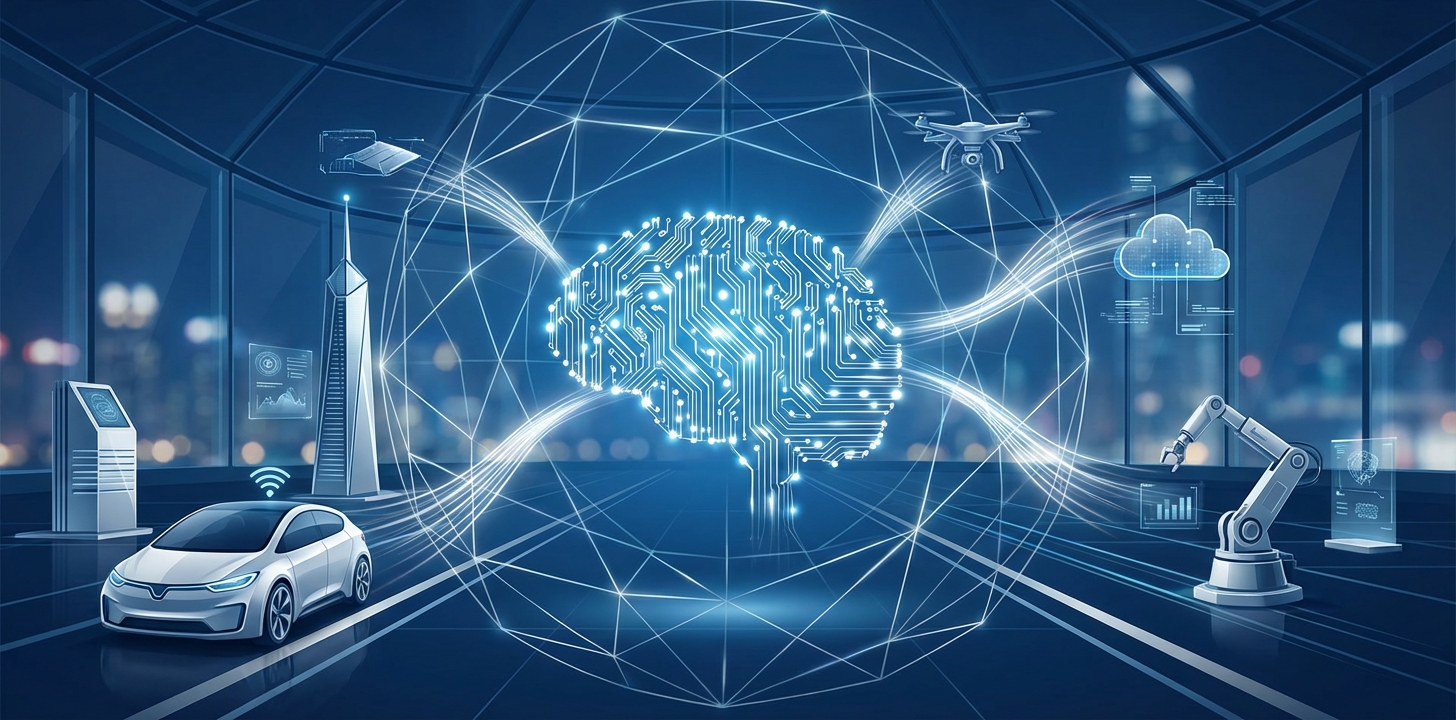
The Age of Agents: AI has moved

Analysis: How GPT-5.4 and Claude 4 Redefined Reality in 2026
Imagine waking up, grabbing your coffee, and seeing your laptop mouse moving all by itself. No, you haven't been hacked by a ghost. Your AI agent just noticed you have a flight in four hours, saw the traffic alert on your phone, and is currently navigating the airline’s clunky 2010-era website to move your seat to the exit row and pre-order your meal. ☕
This isn’t a sci-fi pitch from a decade ago; this is the reality of March 2026. We have officially moved past the "Chatbot Era"—where we spent half our day coaxing a text box to give us a decent email draft—and entered the "Agentic Era." This past month, the tech giants didn't just release new models; they released digital employees that can actually do things. 🚀
Why This Matters
For the last few years, AI was like a very smart friend who lived in a cage. You could ask them questions, and they’d give you brilliant answers, but they couldn't actually step out and help you with your chores. You still had to copy-paste their advice into your spreadsheets, your emails, and your coding environments.
That cage is now gone. With the release of GPT-5.4 and the new Claude "Computer Use" API, AI has been given "hands." It can now see your screen, move the cursor, click buttons, and manage file systems just like a human would [1].
In plain English: The friction between "thinking" and "doing" has evaporated. This matters because it shifts the value of AI from content generation to task execution. If you’re a business owner, a student, or a creative, your job is no longer about doing the work—it’s about managing the agents that do the work for you. 🛠️
The Big Story
The headline of the month is undoubtedly the "March Madness" of model releases. On March 5, 2026, OpenAI dropped GPT-5.4, the fourth major iteration since the original GPT-5 launch [2]. While previous versions focused on being "smarter," 5.4 focuses on "reliability." It doesn't just guess the right answer; it uses "inference-time scaling" to think through a problem for several seconds before it speaks, virtually eliminating the "hallucinations" that plagued earlier models [4].
But the real shocker? Microsoft—the primary backer of OpenAI—has started playing the field. In a move that left industry analysts stunned, Microsoft’s new Copilot upgrade now uses a "hybrid" approach: GPT-5.4 writes the initial draft, but Claude (from rival Anthropic) critiques and edits it [3].
"Wait, what?" Moment: Imagine Coca-Cola using Pepsi to taste-test their new formula. That’s essentially what Microsoft is doing by blending rival models to ensure the highest quality output.
This "splitting" of the frontier field shows that no single company owns the "best" AI anymore. We are seeing a specialization where different models are used for different parts of a workflow. Here’s a quick look at how the top players stack up right now:
Feature GPT-5.4 Claude Opus 4 Gemini 3 Primary Strength Complex Reasoning Coding & UI Navigation Massive Context (Video/Audio) Key Innovation Low-Latency Logic "Computer Use" API Real-time World Sensing Best For Strategy & Planning Technical Execution Research & Media Analysis Multimodal capability—the ability for AI to see, hear, and speak—is no longer a "cool feature." It is now "table stakes" [11]. If your AI can’t look at a photo of your broken sink and tell you exactly which wrench to buy at the hardware store, it’s already obsolete. US Watch In the United States, the focus has shifted from "Will AI take jobs?" to "How do we regulate these agents?" Microsoft’s newly formed MAI (Microsoft AI) group recently released three foundational models that can transcribe voice, generate 4K video, and create immersive audio environments in seconds [9]. This rapid expansion has put Washington on high alert. There is a growing movement to require "Agentic Transparency"—meaning if an AI agent is the one navigating a website or making a purchase, it must identify itself as a bot. 🇺🇸 Meanwhile, the open-source movement in the US is thriving. Google’s release of Gemma 4 has proven that you don't need a billion-dollar server farm to run a world-class AI; you can now run a model that rivals GPT-4 on a high-end consumer laptop [14]. This is democratizing AI, allowing small American startups to build specialized tools without being beholden to "Big Tech" gatekeepers. China Watch While the US is focused on general-purpose agents, China is doubling down on "Vertical AI"—models specifically trained for manufacturing, logistics, and high-tech hardware. Building on the success of models like DeepSeek R1 from 2025, Chinese firms are integrating AI directly into the "nervous system" of their factories [4]. 🇨🇳 There is a fierce "efficiency war" happening. While American models are getting larger and more compute-heavy, Chinese researchers are finding ways to get the same performance out of much smaller, faster models. This is particularly important for the global "edge computing" market—putting AI into everything from smart glasses to industrial robots without needing a constant high-speed internet connection. Global Signal The worldwide message is clear: The "Digital Divide" is no longer about who has the internet; it’s about who has the best agents. We are seeing a massive shift in how the global economy functions. When an AI can operate software independently, "offshoring" data entry or basic coding jobs becomes less about labor costs and more about infrastructure costs. 🌏 We are also seeing the rise of "Sovereign AI." Countries are no longer content to let their data be processed in Silicon Valley. From the EU to Southeast Asia, nations are investing in their own localized LLMs to ensure their cultural nuances and languages aren't lost in the "Western-centric" training data of the big models. Malaysia Watch For Malaysia, the 2026 AI shift presents a golden opportunity. As a regional hub for data centers and semiconductor testing, Malaysia is perfectly positioned to be the "engine room" for AI in Southeast Asia. 🇲🇾 The introduction of agentic AI means that Malaysian SMEs (Small and Medium Enterprises) can now compete on a global scale. A small boutique in Kuala Lumpur can use a GPT-5.4 agent to manage global shipping, handle multi-lingual customer service in ten different languages, and optimize their digital marketing—all for the cost of a monthly subscription. Fun Fact: Did you know that by April 2026, the total history of LLM development—from the first neural networks in the 1950s to today’s reasoning agents—spans over 75 years, but 90% of the progress happened in just the last 36 months? [5] 🤯 What to Do Next
- Audit Your Workflow: Look for tasks that require you to "bridge" two pieces of software (e.g., taking data from a PDF and putting it into Excel). These are the first tasks you should delegate to a "Computer Use" agent like Claude.
- Experiment with Hybrid Models: Don't stick to just one AI. Follow Microsoft’s lead—use one model for brainstorming and another (like Claude or Gemini) for proofreading and technical verification.
- Prioritize "Human-in-the-Loop": As agents become more autonomous, your value lies in judgment, not execution. Focus on learning how to give high-level strategic direction rather than getting bogged down in the "how-to."
- Stay Local, Think Global: If you're in Malaysia or another emerging market, look for ways to apply these global tools to local problems, such as localized logistics or regional language support.
TL;DR - The Age of Agents: AI has moved
Found this article helpful? Share it with others!
Quick AI FAQ
How does this AI development affect Malaysian businesses?
Local businesses can leverage these AI breakthroughs to automate repetitive tasks, improve customer engagement via smart chatbots, and scale content production with 80% lower costs.
Is it safe to integrate AI into existing workflows?
Yes, when implemented with professional oversight. We focus on secure, privacy-compliant AI integrations that align with Malaysia's PDPA regulations.
Where can I get help with AI implementation in Penang?
JOeve Smart Solutions provides on-site and remote AI consultation for SMEs in Penang and across Malaysia, specializing in web apps, chatbots, and video automation.