Feature | 2024 Chatbots | 2026 AI Agents
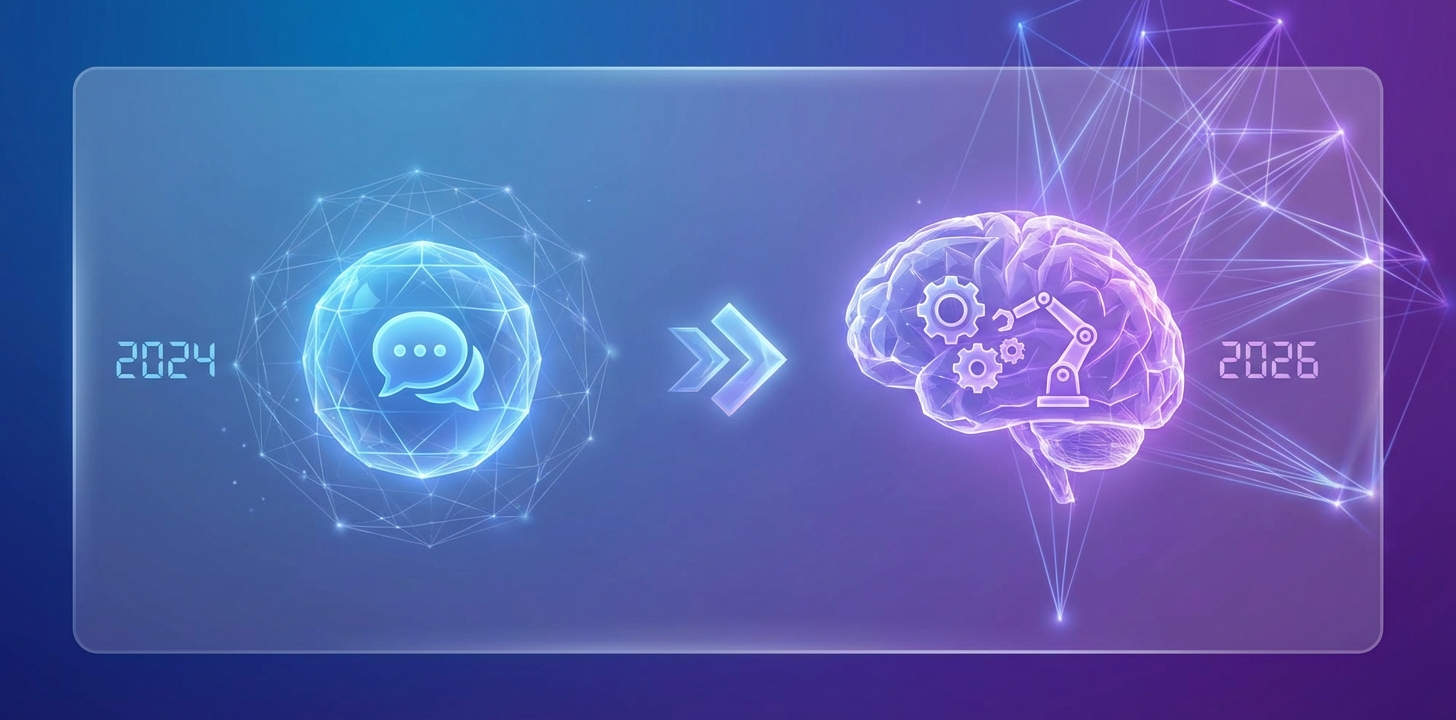
Imagine waking up on a Tuesday morning in 2026. You don’t check your emails. You don’t scan your Slack notifications. You don’t even look at your calendar. Instead, you sip your coffee while your “Chief of Staff”—a digital entity living on your laptop—gives you a thirty-second verbal briefing: “I’ve cleared your inbox, rescheduled your 10 AM because the client hasn't finished their review, and I’ve drafted the first version of the quarterly report based on last night's data. Do you want to review the draft now, or should I start on the slide deck?”
This isn't a scene from a sci-fi movie; it’s the reality of the 2026 AI Agent Revolution that is currently unfolding before our eyes. We are moving past the era of "Chatbots" where we had to beg an AI to write a poem or a polite email. We have officially entered the era of Agentic AI, where software doesn't just talk—it does. If 2023 was the year of the prompt and 2024 was the year of the video, 2026 is the year the AI gets a job and starts doing the work for you [1].
Why This Matters
For the last few years, AI has been like a very smart, very enthusiastic intern who knows everything but can’t actually be trusted to touch the buttons. You had to copy-paste everything. You were the "glue" holding the tasks together.
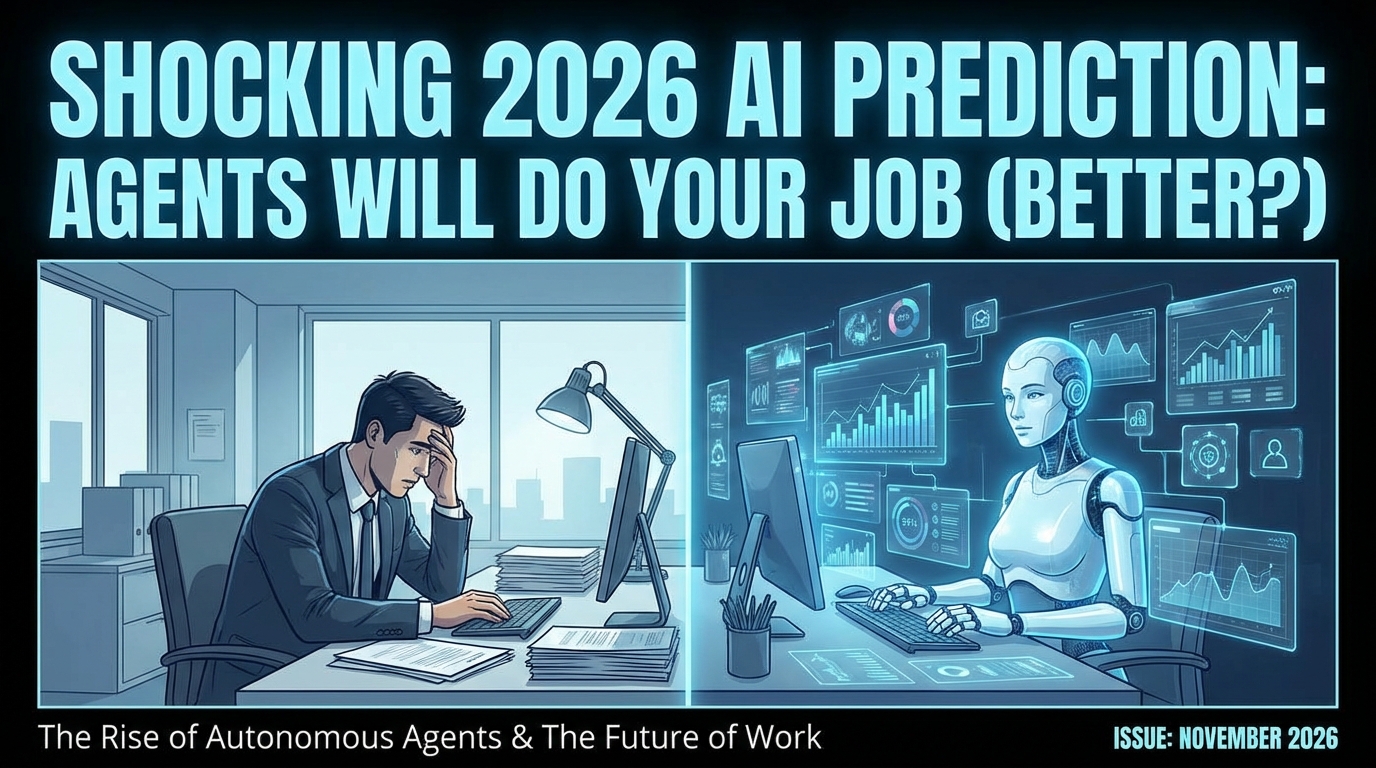
In 2026, the "glue" is being replaced by autonomous agents. This matters because it shifts the human role from "doer" to "director." Instead of spending four hours building a spreadsheet, you spend four minutes telling an agent what you need the spreadsheet to accomplish.
This shift is redefining enterprise automation and personal productivity. It means that small teams can now operate with the power of large corporations, and individuals can automate the "boring stuff" that eats up 60% of their day. We are laying the foundations for a decade-long transformation where "agentic workflows" become the standard operating procedure for every business on the planet [3].
The Big Story
The headline story of 2026 is the death of the "Single Prompt" and the rise of the "Multi-Agent System." Think of it like this: Instead of asking one AI to build a whole website (which usually leads to bugs and frustration), you now use a platform like CrewAI. This platform allows you to hire a "Manager Agent," a "Coder Agent," and a "QA Tester Agent" who all talk to each other to finish the project [1].
Wait, what? They talk to each other? Yes. In 2026, your AI agents are literally having meetings in the background while you sleep. They debate the best way to solve a problem, check each other's work, and only ping you when they hit a roadblock they can't solve.
One of the biggest breakthroughs comes from Anthropic with Claude Code. Unlike previous versions that just gave you snippets of code, Claude Code is now a "coding partner" that actually ships the product. It can access your file system, run terminal commands, and fix its own errors in real-time [1].
| Feature | 2024 Chatbots | 2026 AI Agents |
|---|---|---|
| Action | Generates text/images | Executes tasks across apps |
| Autonomy | Needs constant prompting | Works independently for hours |
| Integration | Copy-paste required | Direct API/Tool access |
| Goal-Oriented | Answers questions | Solves complex problems |
| Memory | Limited to current chat | Long-term context & learning |
| This isn't just about coding, though. Tools like Gumloop, n8n, and Zapier Central are allowing non-technical people to build these agents. You don't need a PhD in Computer Science anymore; you just need to know how to describe your workflow [6] [7]. |
"Agentic AI is rapidly emerging as one of the most important shifts in enterprise automation. It's no longer about whether AI can do the task, but how efficiently it can orchestrate a sequence of tasks." — CloudKeeper Insights [2]
US Watch
In the United States, the race for "Agent Supremacy" has reached a fever pitch. Silicon Valley is no longer obsessed with just making LLMs "smarter"—they are making them "useful."
Salesforce has gone all-in with Agentforce in Slack, effectively turning your workplace chat app into a command center where AI agents handle customer support, sales leads, and data entry without human intervention [9]. Meanwhile, Google is revamping its entire personal assistant ecosystem. The new Gemini-powered assistant is moving away from simple voice commands like "Set a timer" to "Organize my entire trip to Chicago, including booking the flight and sending the itinerary to my wife" [11].
The money is following the trend. VoiceRun, a startup building a full-stack voice AI platform for agents, just raised $5.5 million in early 2026, signaling that investors are betting heavily on AI that can "hear" and "act" in real-time [5].
China Watch
While the US focuses on productivity and personal assistants, China is doubling down on Industrial Agentic AI. Companies like Baidu and Alibaba are integrating agents directly into the manufacturing and logistics supply chains.
In China, the focus is on "Vertical Agents"—AI systems designed for specific industries like high-speed rail maintenance or smart city management. These agents don't just write emails; they monitor sensor data from factories and autonomously order replacement parts before a machine even breaks down. This "predictive agency" is where China aims to lead, moving AI from the office to the factory floor.
Global Signal
The global signal is clear: we are seeing the birth of the Agentic Economy. This is a world where the primary "workers" in the digital space are autonomous software systems.
This shift is demanding a massive overhaul of organizational structures. Forbes reports that HR departments are now having to figure out how to "hire" and "manage" digital agents alongside human employees [4].
Wait, here's what everyone's missing: The real bottleneck isn't the AI's intelligence anymore; it's the infrastructure. To move an AI agent from a prototype to a production system that handles millions of tasks, companies are having to rebuild their entire tech stack to be "Agent-Ready" [14]. It's like having a Ferrari but realizing you're still driving on a dirt road.
Fun Fact: By the end of 2026, it is predicted that the average office worker will interact with more AI agents than human colleagues on a daily basis.
Malaysia Watch
For Malaysia, this 2026 revolution presents a "leapfrog" opportunity. As a hub for digital nomads and a growing tech ecosystem in places like Cyberjaya and Bangsar South, Malaysian SMEs (Small and Medium Enterprises) can use agentic tools to compete on a global scale.
Imagine a small batik business in Terengganu using a multi-agent system built on n8n or Make to handle international shipping, currency conversion, and multi-lingual customer service in 10 different languages simultaneously [7].
The Malaysian government's focus on the digital economy aligns perfectly with this. Local startups are beginning to explore "AI Orchestration"—the art of making different AI tools work together. For Malaysians, the message is clear: You don't need to build the next GPT-5; you just need to be the best at using it to solve local problems.
What to Do Next
If you want to stay ahead of the curve in this agentic era, here are your marching orders:
- Stop Chatting, Start Building: Move away from just using ChatGPT as a search engine. Start experimenting with tools like Zapier Central or CrewAI to see how agents can perform multi-step tasks for you [1] [10].
- Audit Your Workflow: Look for repetitive tasks that require moving data from one app to another. These are the first things you should delegate to an agentic system using platforms like Gumloop or Relay.app [6].
- Focus on Orchestration: Learn how to manage multiple AI models. The future belongs to the "AI Manager" who knows when to use Claude for coding and Gemini for data analysis
10</mcre
Found this article helpful? Share it with others!
Quick AI FAQ
How does this AI development affect Malaysian businesses?
Local businesses can leverage these AI breakthroughs to automate repetitive tasks, improve customer engagement via smart chatbots, and scale content production with 80% lower costs.
Is it safe to integrate AI into existing workflows?
Yes, when implemented with professional oversight. We focus on secure, privacy-compliant AI integrations that align with Malaysia's PDPA regulations.
Where can I get help with AI implementation in Penang?
JOeve Smart Solutions provides on-site and remote AI consultation for SMEs in Penang and across Malaysia, specializing in web apps, chatbots, and video automation.