Shocking 2026 AI Prediction: Agents Will Do Your Job (Better?)
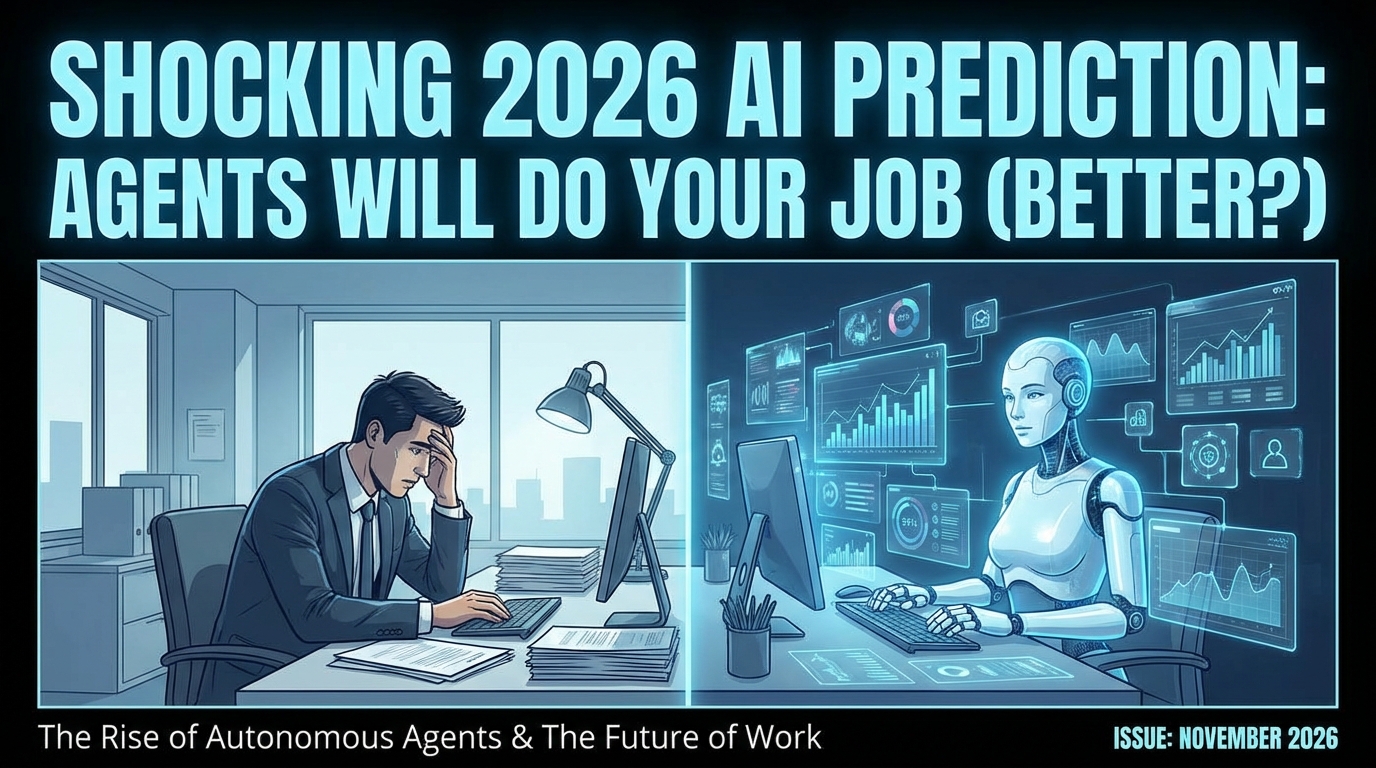
Excerpt: Get ready! By 2026, AI agents won't just automate tasks, they'll own entire workflows. Discover how this shift will reshape your career & life! 🤯
Opening Hook
Imagine waking up in 2026. Your coffee is brewed perfectly by an AI barista. Your schedule is optimized by an AI assistant anticipating your every need. And at work? Well, large parts of your job are handled by AI agents autonomously navigating complex projects, making decisions, and even… collaborating with other AI agents. Sound like science fiction? Think again.
The buzz around "agentic AI" is reaching fever pitch, and 2026 is shaping up to be the year these autonomous systems move from labs to real-world dominance. But are we ready for a world where AI agents are our colleagues, our assistants, and potentially, our replacements?
Why This Matters
Forget simple automation. Agentic AI is a whole different ballgame. Instead of just executing pre-programmed instructions, these AI systems can learn, adapt, and make decisions independently. Think of it like upgrading from a Roomba vacuum cleaner (which just follows a set path) to a self-driving car (which navigates unexpected situations).
This means:
- Increased productivity: AI agents can handle repetitive tasks, freeing up humans for more creative and strategic work.
- Faster innovation: AI can analyze massive datasets and identify patterns that humans might miss, accelerating the pace of discovery.
- New business models: Agentic AI could enable entirely new ways of providing services, from personalized healthcare to automated supply chains.
But there's a catch (or several): - Job displacement: As AI agents take over more tasks, some jobs will inevitably be lost.
- Ethical concerns: Who is responsible when an AI agent makes a mistake? How do we ensure these systems are fair and unbiased?
- Security risks: Autonomous AI agents could be vulnerable to hacking or manipulation, with potentially devastating consequences.
The shift to agentic AI is coming, ready or not. Understanding its potential and its pitfalls is crucial for navigating the future of work and society.
The Big Story
The core idea behind agentic AI is to create systems that can perceive their environment, set goals, plan actions, and execute those actions autonomously. [1] Unlike traditional AI, which requires constant human supervision, AI agents are designed to operate with minimal intervention. This is achieved through a combination of technologies, including: - Large Language Models (LLMs): Providing the agent with natural language understanding and generation capabilities, allowing it to communicate with humans and other systems.
- Planning Algorithms: Enabling the agent to develop strategies and plans to achieve its goals.
- Reinforcement Learning: Allowing the agent to learn from its experiences and improve its performance over time.
- Memory and Context Management: Enabling agents to remember prior events, use context, and achieve long-term goals.
According to a recent report by Salesforce, some of the top AI agents expected to make waves in 2026 include Agentforce (for enterprise solutions), Moveworks (for IT support), and Jasper (for content creation). [2]
"Agentic AI is not just about automating tasks; it's about creating systems that can think and act independently," says Dr. Elara Ramirez, a leading AI researcher at MIT. "This has the potential to transform every industry, from healthcare to finance to manufacturing."
Wait, what? Cyber espionage is mentioned in the same breath as email triage when talking about agentic AI? [11] That highlights just how broad the potential applications (and risks) are!
US Watch
In the US, the development of agentic AI is being driven by both tech giants and startups. Companies like OpenAI, Google, and Anthropic are investing heavily in LLMs and other core technologies, while smaller firms are focusing on specific applications. - OpenAI: While known for ChatGPT, OpenAI is also working on more advanced AI agents capable of performing complex tasks autonomously. Their recent focus on "operational gaps" in deploying these agents highlights the challenges of ensuring security and reliability. [4]
- ServiceNow and UiPath: These companies, traditionally focused on workflow automation, are positioning themselves as leaders in the agentic AI space. [3]
- Vellum.ai: Vellum.ai is focusing on low-code AI workflow automation tools, lowering the barrier to entry for many companies that want to leverage AI agents. [7]
The US government is also paying close attention to agentic AI, with agencies like the Department of Defense exploring its potential for military applications (yikes!). However, there's growing concern about the need for regulations to ensure these technologies are used responsibly.
China Watch
China is rapidly emerging as a major player in the agentic AI arena. The Chinese government has made AI a national priority, investing heavily in research and development. - Baidu: Baidu is developing its own LLMs and AI agents, with a focus on applications in areas like autonomous driving and smart cities.
- Alibaba: Alibaba is exploring the use of AI agents to optimize its e-commerce operations and improve customer service.
- SenseTime: SenseTime is a leading AI company specializing in computer vision and facial recognition, technologies that are crucial for many agentic AI applications.
China's approach to AI development is often characterized by a more top-down, centralized approach compared to the US. This allows for faster deployment of AI technologies but also raises concerns about privacy and human rights.
Global Signal
The rise of agentic AI is a global phenomenon, with countries around the world vying for leadership in this transformative technology.
Here's what everyone's missing: The real competition isn't just about building better AI models, it's about creating ecosystems that support the development and deployment of AI agents. This includes: - Data infrastructure: Access to large, high-quality datasets is essential for training AI agents.
- Computing power: Training and running AI agents requires significant computing resources.
- Talent pool: A skilled workforce is needed to develop, deploy, and maintain AI agents.
- Regulatory framework: Clear and consistent regulations are needed to ensure the responsible use of AI agents.
The countries that can build these ecosystems most effectively will be the ones that reap the greatest benefits from agentic AI.
Malaysia Watch
So, where does Malaysia fit into all of this? While Malaysia may not be at the forefront of AI research and development, there are still significant opportunities to leverage agentic AI for economic growth and social progress. - Manufacturing: AI agents can be used to automate manufacturing processes, improve quality control, and reduce costs.
- Agriculture: AI agents can be used to optimize crop yields, manage irrigation, and monitor livestock.
- Tourism: AI agents can be used to personalize travel recommendations, provide customer support, and enhance the overall tourist experience.
The Malaysian government is actively promoting the adoption of AI technologies, with initiatives like the National AI Roadmap. However, more needs to be done to address the challenges of data access, computing infrastructure, and talent development.
Fun fact: Malaysia has a unique opportunity to position itself as a hub for AI ethics and governance in Southeast Asia, given its diverse cultural and religious landscape.
What to Do Next
The future of agentic AI is uncertain, but one thing is clear: it's coming, and it will have a profound impact on our lives. Here's what you can do to prepare: - Upskill yourself: Learn about AI technologies and how they are being used in your industry. Focus on skills that are difficult to automate, such as critical thinking, creativity, and communication.
- Embrace change: Be open to new ways of working and be willing to adapt to changing job roles.
- Advocate for responsible AI: Support policies and initiatives that promote the ethical and responsible development and deployment of AI.
- Experiment with AI tools: Start using AI-powered tools in your personal and professional life to get a better understanding of their capabilities and limitations.
- Think critically: Don't blindly trust AI systems. Always question their outputs and be aware of their potential biases.
TL;DR - Agentic AI is poised to transform industries by 2026, automating complex workflows and making independent decisions.
- While promising increased productivity and innovation, agentic AI raises ethical concerns about job displacement and security risks.
- The US and China are leading the charge in AI development, but countries like Malaysia can leverage AI for specific industries.
- To prepare for the future, focus on upskilling, embracing change, and advocating for responsible AI development.
Tags: #AI #LLM #AIAgents #AITools #ChinaAI #USAi #Automation #WorkflowAutomation #PersonalAssistant #2026 #ArtificialIntelligence #MachineLearning #GPT #Claude #Gemini
Found this article helpful? Share it with others!
Quick AI FAQ
How does this AI development affect Malaysian businesses?
Local businesses can leverage these AI breakthroughs to automate repetitive tasks, improve customer engagement via smart chatbots, and scale content production with 80% lower costs.
Is it safe to integrate AI into existing workflows?
Yes, when implemented with professional oversight. We focus on secure, privacy-compliant AI integrations that align with Malaysia's PDPA regulations.
Where can I get help with AI implementation in Penang?
JOeve Smart Solutions provides on-site and remote AI consultation for SMEs in Penang and across Malaysia, specializing in web apps, chatbots, and video automation.