From Handkerchiefs to Backflips: Chinese Robots' Year-Long Leap
From Handkerchiefs to Backflips: Chinese Robots' Year-Long Leap
Last year, they wobbled while twirling handkerchiefs. This year, they're doing backflips and wielding swords.
In just 365 days, China's humanoid robots went from cautious dancers to kung fu masters—and the world watched it happen live on TV.
The Performance That Broke the Internet (Again)
On February 16, 2026, China's Spring Festival Gala—the country's most-watched TV event, comparable to the Super Bowl—featured something unprecedented: over a dozen humanoid robots performing sophisticated martial arts routines alongside human children. [1]
Watch the 2026 performance:
The robots, built by Hangzhou-based Unitree Robotics, executed:
- Backflips and parkour moves [3]
- Sword fighting routines
- Nunchaku demonstrations
- "Drunken boxing" style with fall recovery [1]
- High-speed formation changes while running at 4 m/s [1]
This wasn't just a tech demo. It was the world's first fully autonomous humanoid robot cluster martial arts performance. [2]
Compare It Yourself: 2025 vs 2026
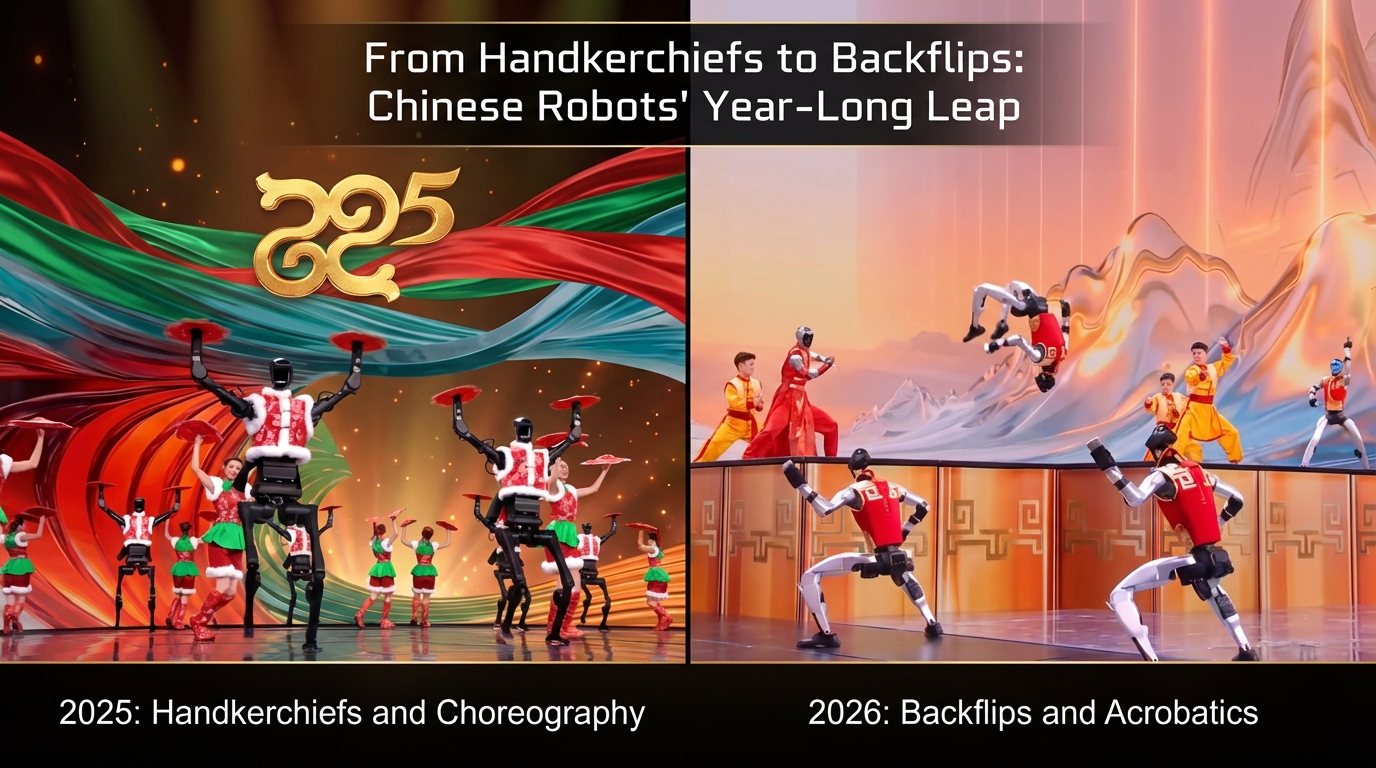
The 2025 Handkerchief Dance:
Last year, 16 Unitree H1 robots performed the Yangge folk dance, directed by renowned filmmaker Zhang Yimou. [5]
The performance went viral—but for different reasons.
The robots moved cautiously, their handkerchief twirling somewhat wobbly. More notably, they required human assistance just to exit the stage. [1]
It was impressive. But it wasn't autonomous.
The 2026 Wushu Performance:
Fast forward one year. The same company's robots are now:
- Running at speeds up to 4 meters per second [1]
- Performing coordinated martial arts with weapons
- Recovering from falls without human help [1]
- Synchronizing with music and human performers to the tenth of a second [3]
The shift? From "pre-programmed puppets" to autonomous machines powered by robust stability algorithms. [1]
Why This Matters (The Real Story)
The robots aren't just entertainment. They're a statement.
The Deals Behind the Show:
Four robotics companies—Unitree, Galbot, Noetix, and MagicLab—reportedly invested 100 million yuan (US$14 million) for their appearance at the gala. [3] [2]
Why? Because the Spring Festival Gala reaches over 1 billion viewers. It's the ultimate marketing platform.
The IPO Pipeline:
Major players including AgiBot and Unitree are preparing for initial public offerings this year. [1]
The gala performance isn't just about showing off—it's about building hype before going public.
The Cost Revolution:
The cluster effect of China's robotics supply chain has allowed companies like Unitree to target production costs below $20,000 per humanoid robot. [1]
That's "EV-ifying" robotics—driving down prices through scale before competitors can finalize their designs.
Malaysia Watch: What This Means for Us
The Opportunity:
Unitree's humanoid robots are becoming commercially available. In 2025, the company claimed shipment volume ranked #1 worldwide. [2]
For Malaysia, this presents several angles:
Manufacturing automation: Sub-$20,000 humanoids could transform Malaysian factories, warehouses, and logistics operations.
Tourism and hospitality: Imagine robots greeting guests at hotels, performing cultural demonstrations, or guiding tourists at attractions.
Education and training: Robots could assist in vocational training, particularly for dangerous or repetitive tasks.
Healthcare support: With Malaysia's aging population, humanoid robots could help with elderly care, patient transport, and routine hospital tasks.
The Risk:
China is clearly positioning itself as the global leader in humanoid robotics. If Malaysia doesn't develop its own capabilities or partnerships, we risk becoming dependent on foreign technology for critical infrastructure.
China Watch: The National Strategy
Beijing utilized the gala to highlight its strategic focus on the robotics sector. [3]
This isn't just about entertainment. It's about industrial policy.
The Message:
By showcasing humanoid robots on the country's biggest stage, China is signaling:
- We can build world-class robotics
- Our supply chain is mature enough for mass production
- We're ready to compete globally
The Monkey King Moment:
In a particularly theatrical touch, Unitree's H2 robot appeared at a sub-venue in Yiwu dressed as the Monkey King, wielding a golden cudgel while standing atop a "somersault cloud" operated by B2W quadruped robot dogs. [5]
This blend of folklore and physics turned a cultural holiday into a showcase for national industrial prowess. [3]
US Watch: The Robotics Gap
While US companies like Boston Dynamics and Tesla are developing humanoid robots, China is demonstrating at scale.
The 2026 gala proved that the hardware can survive intense, high-speed operation without mechanical failure. [3]
That's not a prototype. That's production-ready.
The Competition:
- Tesla Optimus: Still in development, limited public demonstrations
- Boston Dynamics Atlas: Impressive but not commercially available at scale
- Figure AI: Focused on industrial applications, limited public showcases
- Unitree: Just performed live on national TV with 1 billion viewers
China isn't just catching up. It's demonstrating.
What to Do Next
For Malaysian Businesses:
Monitor Unitree's commercial availability: The company is preparing for IPO and likely wants market penetration. Watch for distribution partnerships in Southeast Asia.
Evaluate use cases: Where could humanoid robots add value in your operations? Warehousing? Customer service? Manufacturing?
Budget for automation: Sub-$20,000 robots are approaching price points that make ROI calculations work for many businesses.
For Government:
Develop a national robotics strategy: If humanoid robots are becoming practical, Malaysia needs a plan for adoption, regulation, and workforce adaptation.
Partner with Chinese companies: Rather than trying to build everything domestically, consider partnerships for technology transfer and local manufacturing.
Invest in robotics education: Malaysian universities should prepare students to work with, maintain, and improve humanoid robots.
For Developers:
Learn robot programming: As humanoids become more common, skills in ROS (Robot Operating System), motion planning, and robot control will be valuable.
Build applications: What software can run on humanoid robots? Voice interfaces? Vision systems? Task automation?
The Contrarian Take
Most coverage is focusing on the "wow factor"—robots doing kung fu!
But here's what everyone's missing:
The real story isn't the martial arts. It's the fall recovery.
The "drunken boxing" routine wasn't just flashy—it demonstrated that these robots can fall down and get back up without human intervention. [1]
That's the difference between a demo robot and a practical robot.
If a robot can work in a factory, fall, recover, and keep working—that's production-ready.
If it can perform martial arts on live TV with a billion people watching—that's marketing-ready.
Unitree just proved both.
Watchlist
This Week:
- Unitree's IPO announcement details
- International distribution partnerships
- Reactions from US robotics companies
This Month:
- Commercial availability and pricing
- First enterprise deployments
- Competitor responses
This Quarter:
- Malaysia's robotics policy announcements
- Southeast Asian adoption rates
- Unitree's next-generation models
Bottom Line
In one year, Chinese humanoid robots went from needing human help to exit the stage to performing autonomous martial arts with weapons.
That's not incremental progress. That's exponential.
For Malaysia, the question isn't whether humanoid robots will become practical—they already are. The question is whether we'll adopt them early enough to gain competitive advantage, or late enough to be playing catch-up.
The robots aren't coming. They're already here. And they know kung fu.
Sources:
- Reuters (Feb 16, 2026): China's humanoid robots take centre stage for Lunar New Year showtime [1]
- South China Morning Post (Feb 2026): Humanoids go mainstream as China's robotics champions appear [2]
- PR Newswire (Feb 17, 2026): Kung Fu Meets Spring - Unitree Spring Festival Gala Robots [2]
- GeoPolitechs (Feb 2026): Kung Fu Robot at the 2026 Spring Festival Gala [3]
- Interesting Engineering (Feb 2026): Video: Humanoid robots perform drunken kung fu with nunchucks [3]
- CGTN (Feb 17, 2026): China's Spring Festival Gala becomes Super Bowl-like stage for humanoid robots [1]
- Global Times (Feb 2026): Parkour, Drunken Fist and nunchaku, Unitree humanoid robots wow audience [5]
- India Today (Feb 17, 2026): Watch Humanoid robots perform Kung Fu at China's Spring Festival Gala [4]
- TechEBlog (Feb 2026): Unitree's Robots Delivered a Martial Arts Masterclass [4]
Found this article helpful? Share it with others!
Quick AI FAQ
How does this AI development affect Malaysian businesses?
Local businesses can leverage these AI breakthroughs to automate repetitive tasks, improve customer engagement via smart chatbots, and scale content production with 80% lower costs.
Is it safe to integrate AI into existing workflows?
Yes, when implemented with professional oversight. We focus on secure, privacy-compliant AI integrations that align with Malaysia's PDPA regulations.
Where can I get help with AI implementation in Penang?
JOeve Smart Solutions provides on-site and remote AI consultation for SMEs in Penang and across Malaysia, specializing in web apps, chatbots, and video automation.