Shocking 2026 AI Breakthrough: OpenAI Joins Pentagon as China Reveals Robots!
Opening Hook
Imagine waking up to find that the "safest" AI company in the world has been banned by the U.S. government overnight. 😱 That is exactly what just happened. In a move that has sent shockwaves through Silicon Valley, the landscape of artificial intelligence has shifted from "cool chatbots" to "national security priorities" in the blink of an eye.
We are living in the most chaotic and exciting year for technology yet. While you were sleeping, the U.S. government effectively picked a winner in the AI race, OpenAI secured enough funding to buy a small country, and China just proved that its humanoid robots are ready to move from the lab to the factory floor. Grab your coffee—we’ve got a lot to talk about. ☕️
Why This Matters
In plain English? The "playtime" phase of AI is over. We used to talk about AI writing poems or making funny pictures of cats. In 2026, AI is now about two things: Defense and Dominance. 🛡️
When the President of the United States orders federal agencies to stop using a specific AI because of "supply risks," it tells you that these models are now considered critical infrastructure, just like power grids or water lines. If your business or job relies on these tools, the provider you choose matters more than ever.
Furthermore, the sheer amount of money flowing into this sector is staggering. We aren’t talking about millions anymore; we are talking about hundreds of billions. This level of investment means the AI tools you use next month will be exponentially more powerful than what you have today. It’s a "level up" for humanity, but only if we can keep up with the pace. 📈
The Big Story: The Pentagon’s New Brain
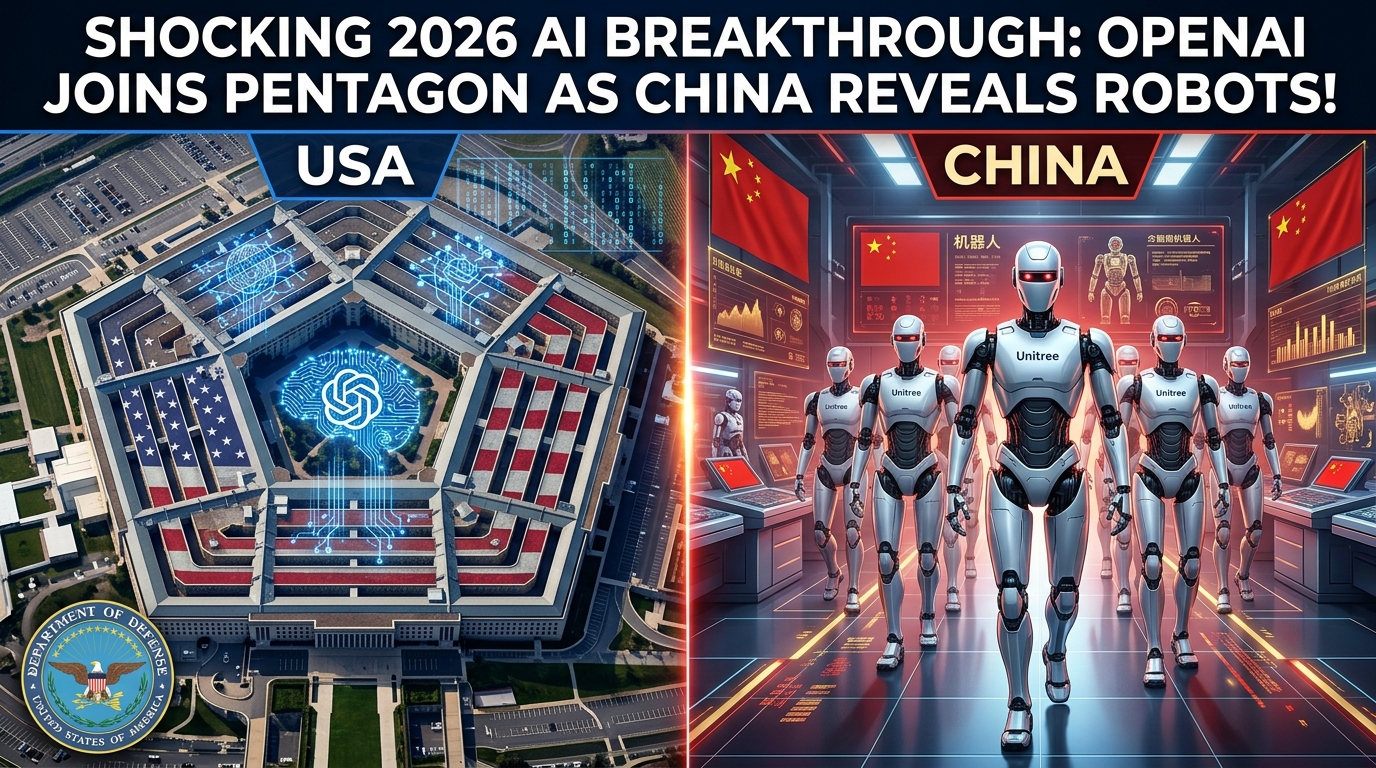
The headline that stopped everyone in their tracks this week: OpenAI has officially reached an agreement with the U.S. Department of Defense. [1] This deal didn't happen in a vacuum. It came just hours after President Trump ordered all federal agencies to "IMMEDIATELY CEASE" using technology from Anthropic, citing the startup as a "supply risk." [2] [3]
Wait, what? Anthropic, the company known for its "Constitutional AI" and focus on safety, is out? Yes. The administration expressed concerns over the company's ethics framework and how it might conflict with national interests. [4] This has paved the way for Sam Altman and OpenAI to step in as the primary AI partner for the American military.
CEO Sam Altman has been quick to clarify that the military will not use OpenAI’s models for "killing," but rather for logistics, data analysis, and cyber defense. [2] Whether you believe that or not, one thing is clear: OpenAI is now the "official" AI of the U.S. government.
OpenAI vs. Anthropic: The 2026 Status Check
| Feature | OpenAI | Anthropic |
|---|---|---|
| Federal Status | Preferred Partner 🇺🇸 | Banned/Restricted 🚫 |
| Latest Funding | $110 Billion [14] | Under Pressure |
| Primary Focus | General Intelligence & Defense | Safety & Research |
| Key Allies | Microsoft, Nvidia, Amazon, SoftBank | (Formerly) Google, Amazon |
US Watch
The United States isn't just playing defense; it’s spending like there’s no tomorrow. OpenAI just secured a mind-blowing $110 billion in funding from a trio of tech giants: Amazon, SoftBank, and Nvidia. [14] To put that in perspective, that’s more than the entire market cap of many Fortune 500 companies.
But it’s not just OpenAI. The money is flowing everywhere in Silicon Valley:
- Waymo raised $16 billion this month, valuing the self-driving leader at $126 billion. [12]
- Databricks secured $7 billion to fuel its data-intelligence platform. [12]
- Cognition AI (the creators of Devin) is now valued at over $2 billion after their latest round. [13]
There’s also a massive internal war brewing over regulation. President Trump has signed orders discouraging states from creating their own AI laws, specifically targeting a Colorado law that bans "algorithmic discrimination." [8] [9] The goal? A single, unified national policy that lets AI companies run as fast as possible without being tripped up by local rules. 🏃♂️💨
China Watch
While the U.S. is focused on funding and defense, China is focused on efficiency and physical execution. 🇨🇳
DeepSeek has become the name on everyone’s lips. While American models are getting larger and more expensive to run, DeepSeek has perfected "distillation"—making smaller models that perform just as well as the giants but at a fraction of the cost. They are proving that you don't need a $100 billion cluster to be smart. 🧠
The Humanoid Revolution:
The big news out of Beijing this week is the deployment of the next generation of humanoid robots from companies like Unitree and Figure-partnered firms in China. These aren't just clunky machines; they are being integrated into Alibaba’s logistics warehouses and Tencent’s data centers. 🤖
Key Chinese Developments:
- ByteDance (TikTok): They have reportedly launched a new video-generation model that makes Sora look like a slideshow. It's already being used to create hyper-personalized ads for millions of users. 📱
- Baidu: Their "Ernie Bot" has now surpassed 600 million users, becoming the "everything assistant" for the Chinese workforce.
- Alibaba & Tencent: Both have pivoted their entire cloud infrastructure to be "AI-first," offering massive discounts to startups that build on their proprietary LLMs.
Fun Fact: Did you know that China currently produces more than 50% of the world's industrial robots? Their goal for 2026 is to have humanoid assistants in 1 out of every 10 urban households. 🏠
Global Signal
The "Global Signal" for 2026 is clear: The AI divide is real. 🌍
We are seeing the emergence of two distinct AI ecosystems. One is led by the U.S., powered by massive capital and deep integration with the military-industrial complex. The other is led by China, focused on manufacturing, robotics, and low-cost, high-efficiency models.
For the rest of the world, the choice is becoming: Do you want the "American Brain" or the "Chinese Body"? Most countries will likely try to use both, but as the trade wars extend into AI chips and data regulations, staying neutral is getting harder.
Think of it like the early days of the Cold War, but instead of nuclear silos, we are building massive data centers. [6] The infrastructure being built right now by Microsoft, Oracle, and Google will dictate who has the "computing power" to lead the next decade. [7]
Malaysia Watch
So, what does this mean for us in Malaysia? 🇲🇾
First, the Data Center Boom is our biggest opportunity. With the U.S. and China racing for compute, Malaysia’s strategic location and growing energy infrastructure make us the perfect "neutral ground" for data processing. Expect more billion-dollar investments in Johor and Cyberjaya as these giants look for places to house their AI brains.
Secondly, the Humanoid Manufacturing sector is a sleeping giant. As China ramps up robot production, Malaysia’s established semiconductor and electronics assembly industry is perfectly positioned to become a key part of the global robot supply chain. We might not build the "brain," but we can certainly build the "limbs." 🦾
Local Tip: If you’re a developer or business owner in Malaysia, stop trying to build your own LLM. Instead, look at DeepSeek and other open-source models to build "localized AI" that understands Manglish, Bahasa Melayu, and our unique cultural nuances. That’s where the real money is!
What to Do Next
- Audit Your AI Stack: If your business relies on Anthropic (Claude), keep an eye on federal guidelines. While you aren't a government agency, the "Trump Ban" might lead to a shift in where developers focus their best features. 🛠️
- Learn "Model Efficiency": Stop chasing the biggest model. Look into "distilled" models like DeepSeek. They are cheaper, faster, and often "good enough" for 90% of tasks.
- Watch the Hardware: If you are an investor, look beyond the software. The real winners of 2026 are the companies building the sensors, motors, and chips for the humanoid robots coming out of China and the U.S. 🏎️
- Prepare for "Agentic" AI: We are moving from "chatbots" to "agents" that actually do things.
Found this article helpful? Share it with others!
Quick AI FAQ
How does this AI development affect Malaysian businesses?
Local businesses can leverage these AI breakthroughs to automate repetitive tasks, improve customer engagement via smart chatbots, and scale content production with 80% lower costs.
Is it safe to integrate AI into existing workflows?
Yes, when implemented with professional oversight. We focus on secure, privacy-compliant AI integrations that align with Malaysia's PDPA regulations.
Where can I get help with AI implementation in Penang?
JOeve Smart Solutions provides on-site and remote AI consultation for SMEs in Penang and across Malaysia, specializing in web apps, chatbots, and video automation.