2026 Shocking AI Breakthrough: China Reveals Free Cars & Kung Fu Bots
Opening Hook
Imagine waking up to a notification that you’ve just won a brand-new electric vehicle simply because you used an AI chatbot to send a Chinese New Year greeting. No, this isn't a scam from 2010; it’s the reality of the 2026 AI landscape in China. 🚗
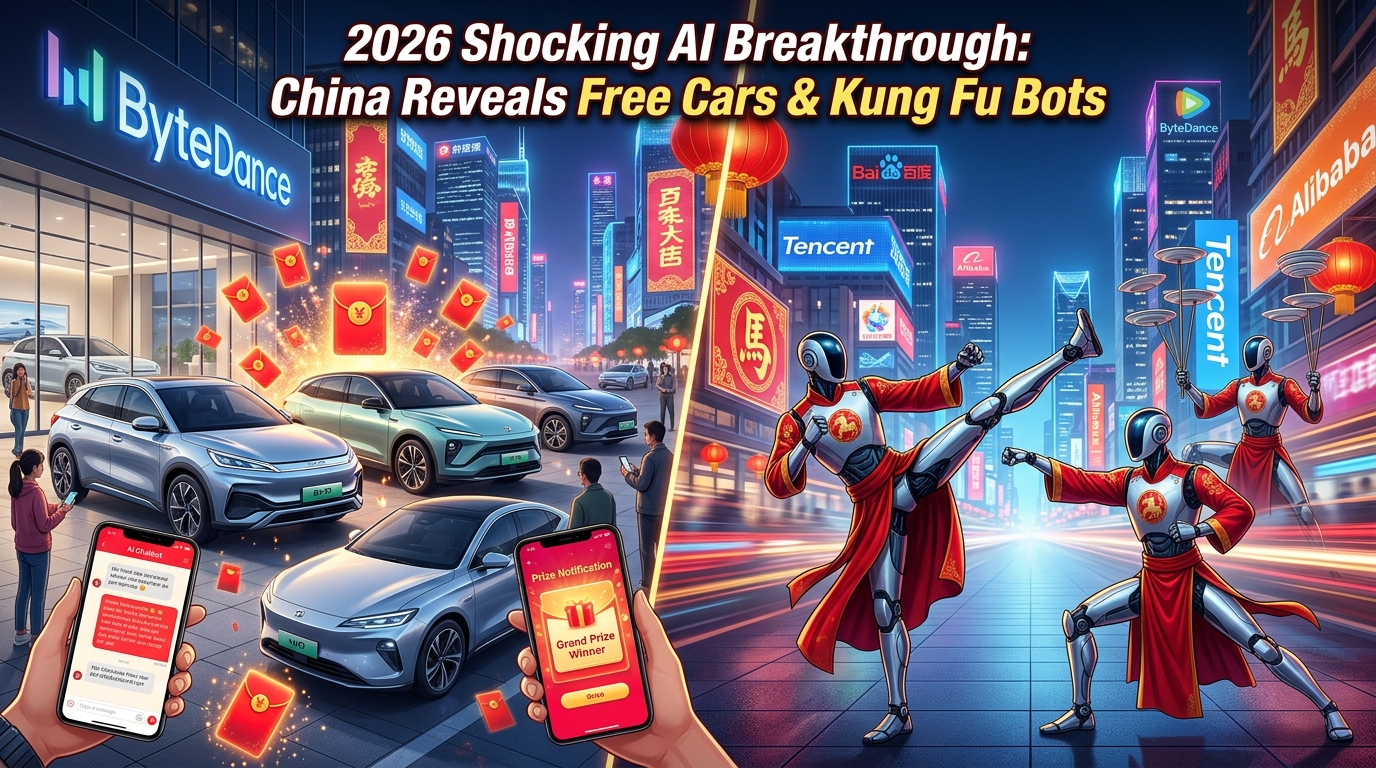
As we kick off the Year of the Horse, the "Big 4" of Chinese tech—ByteDance, Baidu, Tencent, and Alibaba—are engaged in a marketing blitz so aggressive it makes the Super Bowl look like a bake sale. They aren't just fighting for your data anymore; they are fighting for your physical presence in their ecosystems by giving away cash, luxury goods, and high-tech cars. [1]
Wait, what? Why would a multi-billion dollar AI company give away a car for a chat prompt? Because in 2026, the battle for "Attention Equity" has reached a fever pitch. The technology has become so good that the "cool factor" is gone—now, it’s all about who can become the most indispensable part of your daily life. 🧧
Why This Matters
If you think this is just a flashy PR stunt, think again. This matters because we are witnessing the "Commoditization of Intelligence." When AI is everywhere, the price of using it drops to near zero.
In plain English: AI is becoming like electricity. You don’t celebrate when you flip a light switch and the bulb turns on; you only notice when it doesn't work. China is betting that by making AI cheap, accessible, and rewarding, they can hook the global population on their specific platforms before the West even realizes the game has changed. [8]
For the average person, this means the barrier to entry for high-level automation is vanishing. Whether you are a small business owner in Kuala Lumpur or a student in New York, the tools to run your life are becoming incredibly affordable—if you’re willing to use the platforms providing them. 💡
The Big Story
The real headline for 2026 isn't just giveaways; it’s the pivot from "Chatting" to "Doing." We are officially entering the Year of the AI Agent. 🤖
For the past few years, we’ve been impressed by AI that can write poems or code. But 2026 is the year these models get "hands." Alibaba and Baidu are leading the charge in scaled adoption of AI agents—software that doesn't just suggest a vacation but actually books the flights, negotiates the hotel price, and files your expenses while you sleep. [4]
However, it’s not all sunshine and free cars for the giants. Baidu, once the undisputed king of Chinese search, is feeling the heat. Despite a massive 48% growth in their AI-powered business segments, their overall stock took a massive hit, losing nearly 20% of its value recently. [3] [5]
Wait, what? How can AI revenue grow by nearly 50% while the company's value drops? 📉
Here’s what everyone is missing: the market is terrified of the "AI Transition Gap." Investors see the old revenue streams (like traditional search ads) dying faster than the new AI streams can replace them. It’s a classic "Innovator’s Dilemma." Baidu is successfully building the future, but the future is currently less profitable than the past.
| Feature | 2023-2024 AI (The Chat Era) | 2026 AI (The Agent Era) |
|---|---|---|
| Primary Interaction | Typing prompts into a box | Voice commands and "Set & Forget" |
| Capability | Summarizing and Creating | Executing tasks and Solving problems |
| Main Cost | High subscription fees ($20/mo) | Free or "Pay-per-task" |
| Physical Presence | Strictly on your screen | Integrated into cars and home robots |
US Watch
While China is focused on mass adoption and "cheap AI," the United States is doubling down on "Frontier Intelligence." The US remains the home of the most powerful, massive-scale models that require astronomical computing power. 🇺🇸
However, a recent Stanford University report has sent shockwaves through Silicon Valley. The findings suggest that Chinese AI models have not only caught up but, in several key benchmarks, have actually pulled ahead of their American counterparts. [2]
The US strategy is still heavily focused on the "Silicon" part of the equation—controlling the chips. But as China proves, you don't always need the world's most powerful chip if you have the world's most efficient software and the most aggressive data collection strategy.
China Watch
If you thought AI was just software, China is here to remind you that it has a body too. The "Big 5" humanoid robot manufacturers are currently stealing the show at major automation conferences. 🇨🇳
We’ve moved past the era of robots that fall over while trying to open a door. At the recent Spring Festival Gala, startups like Unitree showcased humanoid robots performing complex kung fu routines with fluid, human-like precision. [7]
"We aren't just making toys anymore," one CEO remarked. Unitree expects to ship between 10,000 and 20,000 humanoid units in 2026 alone. These aren't just for shows; they are being prepared for factory floors and even elder care. [6]
Fun Fact: China is now the global leader in AI research publications. They aren't just copying anymore; they are the ones writing the textbook. [9]
Global Signal
The global signal is loud and clear: The AI Cold War is over, and the AI Trade War has begun. 🌍
China’s strategy is to get the world "hooked" on cheap, functional AI. Think of it like the smartphone market. Apple (the US) owns the high-end, luxury segment, but brands like Xiaomi and Oppo (China) dominate the global masses by providing 90% of the features for 30% of the price. 📱
This "Cheap AI" move is a play for the Global South. By offering powerful AI agents and humanoid robots at a fraction of the cost of Western alternatives, China is positioning itself as the backbone of the next industrial revolution in developing nations.
Malaysia Watch
For our readers in Malaysia, this presents a massive "Goldilocks" opportunity. Malaysia is uniquely positioned as a neutral ground where both Western and Eastern AI technologies meet. 🇲🇾
With the rise of AI agents in 2026, Malaysian SMEs (Small and Medium Enterprises) can leapfrog traditional hurdles. Imagine a local "Kedai Runcit" using a cheap, Chinese-integrated AI agent to manage inventory, predict local demand based on weather patterns, and handle multi-language customer service in Malay, Mandarin, and English—all for the price of a Netflix subscription.
Furthermore, as Chinese humanoid makers look for regional hubs for assembly and distribution, Malaysia’s established electronics manufacturing sector (especially in Penang) is a prime candidate for these "Robot Factories." 🏗️
What to Do Next
- Audit Your Tasks, Not Your Jobs: Don't worry about AI replacing your whole job. Instead, identify the 3 most boring tasks you do every day and look for an "AI Agent" (like those from Alibaba or Baidu) to automate them. 📋
- Look Beyond the Hype: When you see a company's stock drop (like Baidu's), look at their "AI Revenue Share." If that number is growing, the company is likely pivoting successfully, regardless of short-term market panic. 📊
- Experiment with "Cheap AI": You don't always need the most expensive GPT-5 or equivalent. Try using open-source or Chinese-developed models for routine tasks to see how the cost-to-performance ratio compares. 🛠️
- Upskill for the "Robot Age": If 20,000 humanoid robots are hitting the market this year, someone needs to know how to maintain, prompt, and manage them. Start looking into "Human-Robot Interaction" basics. 🤖
TL;DR
- Giveaways & Growth: China’s AI giants are giving away cars and cash to win users while Baidu sees massive 48% growth in AI revenue. 🎁
- The Agent Era: 2026 is the year AI shifts from "chatting" to "doing" through autonomous agents. 🏃♂️
- Kung Fu Robots: Humanoid robots are going viral and entering mass production, with 20,000 units expected to ship this year. 🥋
- Global Shift: China is winning the "mass market" by making AI cheap and indispensable, challenging US dominance. 🌏
#AI #LLM #AIAgents #AITools #ChinaAI #USAi #HumanoidRobots #Baidu #Alibaba #TechNews2026 #FutureOfWork #MalaysiaTech #Innovation
Found this article helpful? Share it with others!
Quick AI FAQ
How does this AI development affect Malaysian businesses?
Local businesses can leverage these AI breakthroughs to automate repetitive tasks, improve customer engagement via smart chatbots, and scale content production with 80% lower costs.
Is it safe to integrate AI into existing workflows?
Yes, when implemented with professional oversight. We focus on secure, privacy-compliant AI integrations that align with Malaysia's PDPA regulations.
Where can I get help with AI implementation in Penang?
JOeve Smart Solutions provides on-site and remote AI consultation for SMEs in Penang and across Malaysia, specializing in web apps, chatbots, and video automation.